
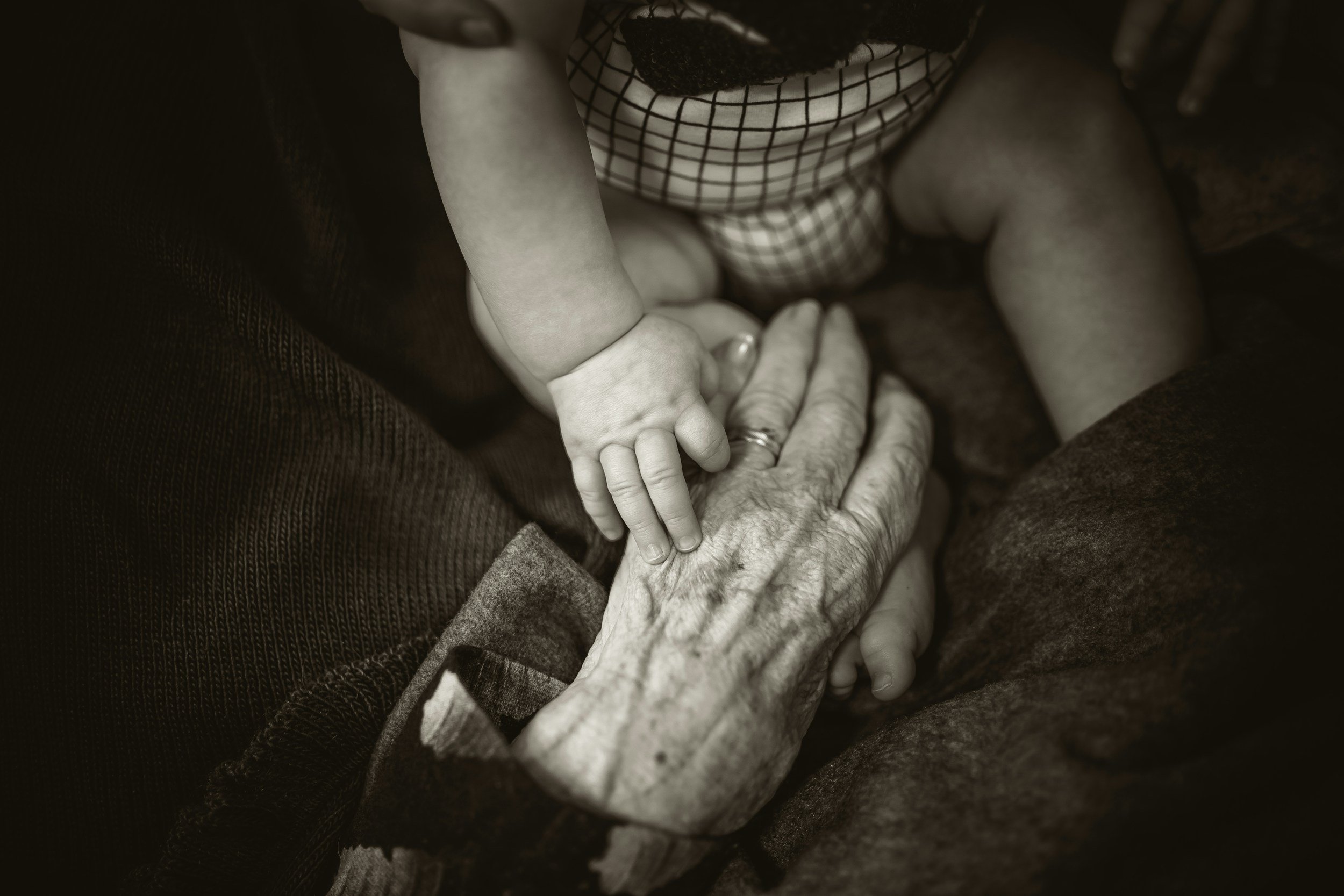
When Francesca Reicherter talks about what got her through her hardest years, the tools come up — the workbooks, the board game, the encouragement cards. But underneath all of it sits something simpler and less visible: a grandfather who called her every morning for coffee, and a grandmother who stayed up all night just to listen.
Those calls weren't therapy. They weren't structured interventions. They were ordinary, daily, low-stakes presence — and according to Reicherter, they mattered as much as anything else in her recovery.
What Steady Presence Actually Looked Like
During college, while Reicherter was pushing herself to finish a four-year degree in two and a half years — working 50 hours a week, barely sleeping, barely eating — her grandfather FaceTimed her every morning for a cup of coffee, and again every evening on her walk to her shift at Build-A-Bear. She'd tell him about the cute boy who sat next to her in class, or the teacher who sprang a pop quiz. Nothing urgent. Nothing clinical. "It really just felt like he cared," she says.
Her grandmother filled a different role — staying up late to listen to Reicherter cry about finance formulas and the general overwhelm of school. Neither grandparent was solving her problems. They were simply showing up, consistently, for the small stuff, which is often what makes someone believable when they show up for the big stuff too.
That consistency is why losing her grandfather in a car accident hit as hard as it did. "I didn't know how to get through a morning, a cup of coffee in the morning without my grandfather, let alone a lifetime," Reicherter says. The loss wasn't just of a person — it was the loss of a specific, daily proof that someone was paying attention to her life.
When the Support System Becomes the Work Itself
What's notable about Reicherter's story is that this dynamic didn't end when she became the one doing the advocacy work. Her grandmother — who survived the same car accident and now lives with Alzheimer's — still colors the encouragement cards Reicherter's nonprofit sends to psych units around the world. Reicherter's mother handwrites the organization's name on the back of each card.
"To this day, whenever she's bored, she'll... she has Alzheimer's now, and she will still know to go and color these cards for someone else who was struggling," Reicherter says, "because she remembers what it was like to have a granddaughter who was struggling." The relationship didn't stay static as a source of one-directional support during a crisis. It evolved into something the whole family participates in — a memory the disease hasn't taken, precisely because it's rooted in something her grandmother lived through with her.
The Research Behind the Instinct
Co-host Scott H Silverman pointed to something broader underneath Reicherter's story: research on family connectedness shows that families who regularly share meals or set time together — even just a couple times a week — tend to do measurably better. Kids in those families get to talk, get listened to, and get told the stories that become their sense of history and belonging. That bonding builds a foundation that shows up later, particularly for people navigating addiction or mental health struggles, many of whom believe they're fundamentally alone and that no one could understand them.
He noted that this kind of presence does something specific: it gives someone proof that another person took the time for them. That proof becomes part of what someone can draw on later, especially in the moments when their own belief in themselves runs out.
Why This Matters for Families Supporting Someone in Crisis
Reicherter's story is a reminder that recovery support doesn't have to be sophisticated to be effective. A daily phone call. Listening without trying to fix anything. Staying present after the crisis has technically passed, not just during it. None of these require clinical training — they require consistency and follow-through.
For families wondering how to help a loved one in recovery, the takeaway from Reicherter's experience isn't to find the perfect words or the right intervention. It's to show up in small, repeatable ways — the kind of presence that, even decades later, someone can still trace their resilience back to.
To learn more about Francesca Reicherter's advocacy work and her family's ongoing role in it, visit francescareicherter.com and inspiringmygeneration.org. For more conversations on mental health, recovery, and family support, visit yourcrisiscoach.com.